Science & Technology
The Science & Technology (S&T) Group works across the Naval Enterprise to provide thought leadership and a forum for new ideas, collaborative opportunities and technology transfer.
This Years Topic: The Minimal Viable Warship
What is a Minimum Viable Warship?
The concept of a Minimum Viable Warship (MVW) challenges traditional assumptions about how naval combat power is generated, sustained and scaled. In its simplest form, a MVW is a warship designed to deliver credible added mass to the fleet, at minimum cost and within a minimum build timeframe. It is not a lesser warship, nor a disposable asset, but a purposeful response to the realities of modern conflict, constrained industrial capacity and the increasing pace of technological change.
Discussions at the recent UKNEST conference on Minimum Viable Warships highlighted a clear caution: complex warships are not easy to design and build affordably. A MVW must still provide a credible blue‑water capability if it is to be operationally valuable. Reducing cost by stripping out endurance, survivability or combat relevance risks producing ships that add numbers without adding meaningful fighting power. The challenge, therefore, lies in redefining what “good enough” looks like in a contested maritime environment.
The conference made clear that delivering a MVW is not about optimising individual vessels, but about re‑thinking how capability is generated at fleet level. The MVW must be conceived as part of a collaborative and hybrid force, operating alongside crewed, uncrewed and allied vessels to deliver distributed sense‑decide‑effect chains. Cost effectiveness must come through standardisation, modularity and the acceptance of off‑the‑shelf solutions, rather than bespoke design.
Equally, speed matters. Shortening the path from concept to operational effect demands a shift towards a war‑footing mindset, including the use of non‑traditional shipyards and more agile regulatory approaches. Above all, the discussion reinforced that success is driven primarily by culture, supported by process and technology. Without cultural change across both industry and navies, the Minimum Viable Warship will remain an idea rather than a reality.
The rest of this article outlines the 6 core aspects of a Minimum Viable Warship:
Collaborative and Hybrid Warfare
Collaborative and hybrid warfare describes a shift from singular complex vessel operations towards a disaggregated fleet approach in which capability is distributed, connected and orchestrated across multiple vessels. In this approach, a Vessel is not expected to operate independently, but as part of a wider system of crewed and uncrewed vessels that together enable a distributed sense‑decide‑effect chain. Sensing, decision‑making and effect are deliberately disaggregated across the force, allowing the fleet to generate mass, resilience and adaptability through coordination rather than concentration.
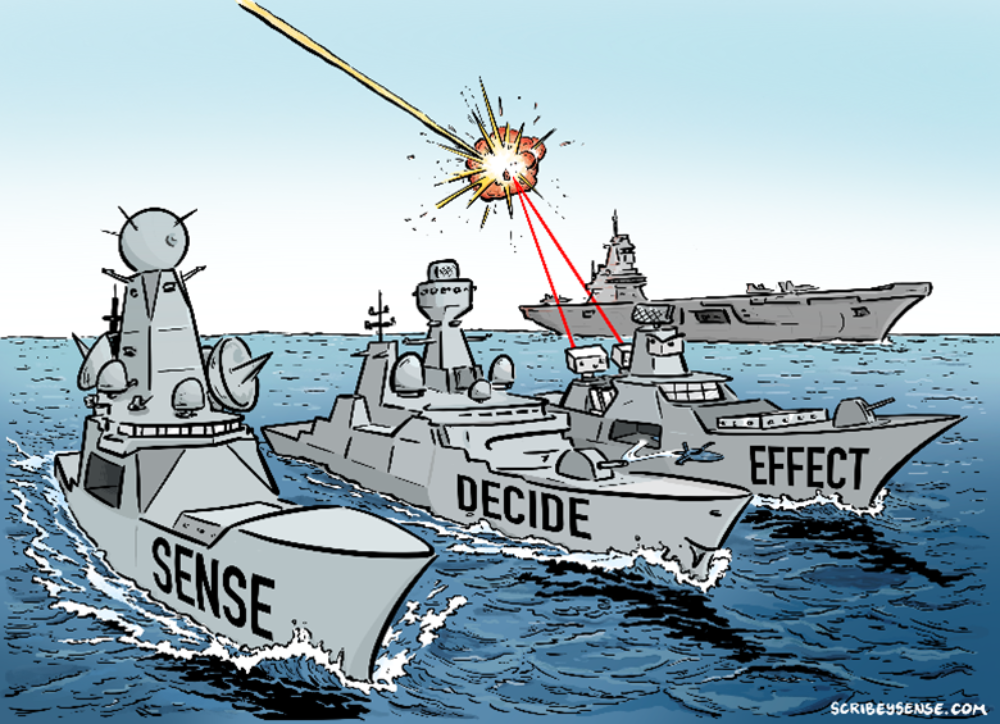
To be successful the vision must go even further than that outlined in the image above, changing not only the operation and design to maximise the benefits of new technologies. Collaborative warfare is not simply about networking individual ships, but about enabling the fleet itself to function as a meshed combat system. Smaller vessels may be widely dispersed rather than operating in close proximity, contributing sensing, deception or specialist functions while remaining connected through resilient networks. The emphasis shifts from physical formations to information flow, decision authority and collective effect.
Integration across vessels and partners is therefore essential. Collaborative warfare relies on interoperability between different classes of vessel, autonomous systems and allied forces, underpinned by shared data, standards and command constructs. This places demands not only on technology, but also on doctrine and organisational culture, particularly where decision‑making is distributed rather than centralised.
Some degree of automation is an enabling requirement, particularly for lean‑crewed or uncrewed vessels, supporting navigation, platform management and persistence. However, automation is not an end in itself. The “decide” element of the sense‑decide‑effect chain remains complex and context‑dependent, meaning human judgement will continue to play a critical role. Automation must therefore be balanced carefully against cost, complexity and genuine operational benefit.
Maintenance emerged as a fundamental challenge for hybrid fleets. While it is often assumed that uncrewed vessels may still require personnel to embark for maintenance, this risks reintroducing the full regulatory and design burden of crewed ships. To realise the full benefit of uncrewed systems, maintenance must be designed out wherever possible. Just as satellites are expected to operate for years without intervention, and aerospace has transitioned away from flight engineers through automation, future naval vessels must adopt a similar philosophy if collaborative and hybrid warfare is to be truly transformative.
Cost Effective Added Mass to the Fleet
Cost‑effective added mass to the fleet is a core principle of the Minimum Viable Warship (while also recognising the future fleet will be a wider mix of ships and craft), but the UKNEST conference discussion highlighted that affordability must be achieved through a fundamentally different approach to design, procurement and delivery. Ships must not be expensive to build, operate and support, while still offering sufficient endurance and robustness to contribute meaningfully to sustained operations. Cost reduction cannot simply come from cutting capability; instead, it must be driven by simplicity, standardisation and by building at scale, ensuring vessels remain operationally credible while avoiding unnecessary complexity; something easier said than done.
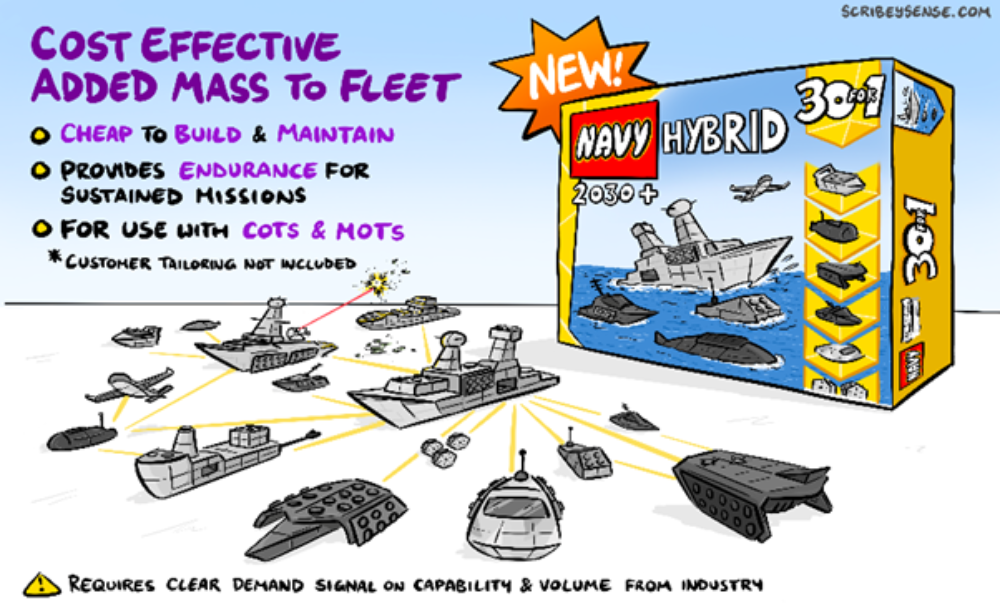
To deliver affordable mass, customers will need to accept MOTS and COTS solutions, utilising what is available rather than tailoring vessels to highly specific requirements. This places a premium on providing a clear, stable and achievable demand signal, both in terms of capability and volume, so industry can invest with confidence and develop generic solutions applicable across multiple users. Changing requirements mid‑programme undermines this model and drives cost back in.
The discussion also pointed to the need to move into a more experimental operating model, where capability is iterated rapidly rather than perfected before delivery. Instead of optimising a vessel, the focus should be on delivering the mission, with ships seen as adaptable enablers rather than fixed end products with a 10 year lead time. High‑level, outcome‑based requirements allow industry to innovate, test and refine solutions quickly, accepting incremental improvement over time. This represents a deliberate shift from risk‑avoidance towards learning through use, and is essential if navies are to generate cost‑effective mass at pace in a contested environment.
Faster flash to bang
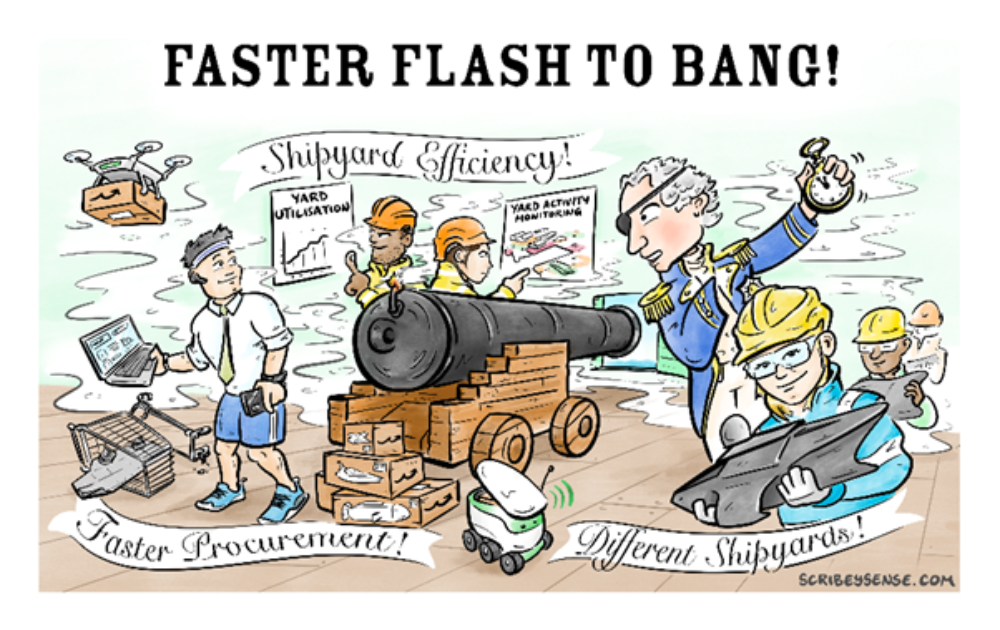
The naval sector needs to dramatically reduce the time between recognising a requirement and delivering usable capability to the fleet. This demands a shift towards acquiring a Minimum Deployable Capability at pace, followed by spiral development to evolve and adapt that capability over time. Such spirals may deliver capability uplifts, progressively lift constraints on use, or, where appropriate, rapidly bin and replace systems with newer models. The discussion highlighted that this is not simply about building ships faster, but about adopting a war‑footing mindset that prioritises speed, adaptability and scale. In a crisis or prolonged conflict, the ability to ramp up production and field additional capability quickly may be as decisive as the performance of individual vessels. A key constraint identified is that existing naval shipyards are already heavily committed.
There is a deeper issue in how ships are built today. It could be argued that something is wrong if it routinely takes over a decade from steel cut to handover. The world’s first nuclear aircraft carrier, CVN‑65, was delivered in less than four years from being laid down, highlighting that the core constraint is not technical complexity but process, governance and industrial practice. Current build programmes occupy the capacity of traditional shipyards for extended periods, leaving little headroom to respond rapidly to new or emergent demands.
If navies wish to scale production at pace this will require a deliberate move beyond established suppliers. Alternative yards, non‑traditional manufacturing facilities and adjacent industrial sectors may all have a role to play, provided designs are sufficiently simple, modular and repeatable to enable rapid manufacture and spiral evolution. However, in order to field a truly blue ocean naval capability, seakeeping requires a larger vessel design which may be outside the build reach of alternative yards.
Embrace Technology
Embracing technology within the Minimum Viable Warship concept is less about adopting specific systems and more about adopting a modular, adaptable approach to capability. The UKNEST discussion emphasised that modularity should not be misunderstood as simply designing a ship with empty spaces or interchangeable “blocks”. Previous approaches that focused on physically swapping large modules in and out of ships have shown limitations and, in some cases, failed to deliver the promised flexibility. Instead, modularity should be understood in terms of capability modules that can be rapidly integrated, upgraded or redistributed across the fleet. This is a non-trivial challenge and will require an open architecture approach and standardisation across the modules and host vessels.
This broader view of modularity goes beyond physical integration. It includes containerised systems, software‑defined capability, scalable sensors, and deployable effectors that can be combined in different ways to deliver a mission. In a hybrid fleet, an anti‑submarine warfare “module”, for example, may consist of a mix of sensors, processing, data links and vessels distributed across multiple vessels rather than residing on a single ship. The ship itself becomes a node in a wider system, contributing to and drawing from a meshed network rather than acting as the sole host of capability.
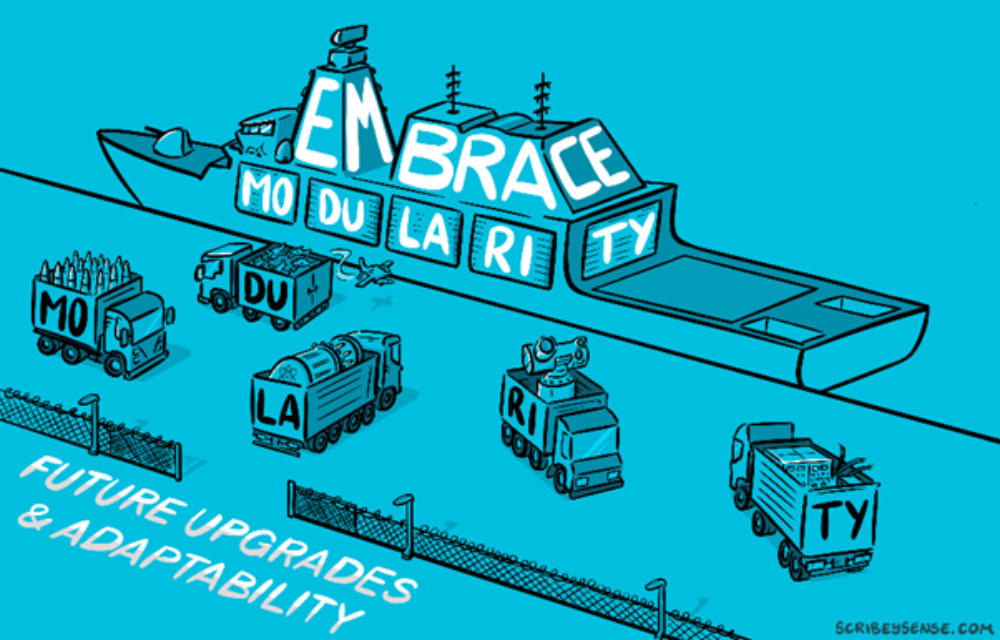
A key enabler of this approach is robust data management, communications and computing infrastructure. The value of modular capability is realised only when information can be shared with low latency and sufficient processing power to ensure the whole is greater than the sum of its parts. Embracing technology therefore means designing vessels and equipment for rapid integration, frequent upgrade and distributed use, enabling capabilities to be swapped, evolved and scaled at pace through spiral acquisition. This approach supports faster adaptation, reduces obsolescence and aligns directly with the mission‑focused, iterative philosophy underpinning the Minimum Viable Warship.
Regulatory Agility and Innovation
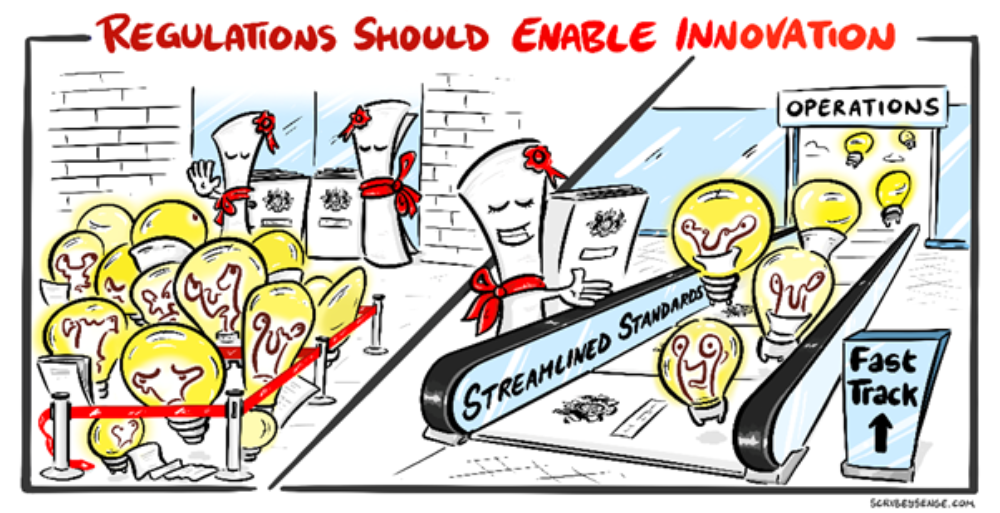
Regulatory agility and innovation were repeatedly identified as critical enablers for delivering a Minimum Viable Warship at pace. The discussion emphasised that regulation should enable innovation rather than constrain it, particularly in areas such as autonomy, modularity and uncrewed systems where technology is evolving faster than traditional standards frameworks. While regulation remains essential for safety, environmental protection and credibility, overly prescriptive rules risk locking in legacy assumptions and slowing the adoption of new approaches.
A strong theme was the value of goal‑based regulation, where regulators set clear outcomes (such as safety, survivability, and environmental protection), rather than dictating detailed technical solutions. In this model, industry and navies are responsible for demonstrating that risks are understood and managed appropriately, supported by evidence, testing and operational experience. Crucially, regulators were not seen as having all the answers in advance; instead, effective regulation emerges through collaboration, experimentation and learning over time.
The discussion recognised that many existing standards were themselves created through trial, failure and iteration, and that today’s challenge is no different. Fast routes to operation, incremental assurance and adaptive standards are therefore essential if innovation is to keep pace with operational need. Regulatory agility is not about lowering the bar, but about working together (regulators, navies and industry) to agree what “safe enough” looks like in a rapidly changing technological landscape, and to align at speed around shared objectives rather than rigid compliance. However, this is not a simple fix, as with any process if not carefully managed, this can be less agile, restrictive and time consuming than prescription.
Cultural Transformation
Cultural transformation was consistently identified as the single most important factor in delivering a Minimum Viable Warship, captured succinctly in the observation that success is 70% culture, 20% process and 10% technology. While technology often dominates discussion, the conference reinforced that cultural behaviours, incentives and operating models ultimately determine whether rapid design, build and deployment are achievable. Without cultural change, new processes and technologies will be absorbed into existing ways of working and fail to deliver meaningful impact.
Crucially, the discussion made clear that this challenge applies equally to both navy and industry. There was recognition that neither side can claim exemption from change; long‑established assumptions around ownership, responsibility and risk need to be re‑examined. Moving towards rapid production of diverse vessels demands a shift away from purely transactional relationships towards more integrated, collaborative models, where industry is more closely involved in operation, support and capability development. Boundaries between design, build, operate and support are likely to blur, with “product‑as‑a‑service” approaches becoming more common.
This cultural shift also underpins the move to a more experimental operating model, with greater tolerance for iteration, learning and managed risk. Thee risk to the operator is increasing as the defence landscape becomes more and more volatile, which will necessitate a shift in risk culture throughout defence i.e. more ‘proportionate’ to the defence landscape and near-war footing. Supporting rapidly evolving vessels requires changes in logistics, training and assurance, alongside a willingness to accept that not every solution will be optimised from day one. Becoming “match fit” for rapid design and build therefore requires aligned cultural change across behaviours, commercial constructs and operating models, enabling speed, adaptability and trust to replace caution, rigidity and perfectionism.

Summary
The Minimum Viable Warship is not a single design solution, but a shift in how naval capability is conceived, delivered and sustained. It prioritises mission effect over vessel perfection, speed over optimisation, and collaboration over self‑contained complexity. As the UKNEST discussions made clear, success depends on integrating collaborative warfare concepts, cost‑effective mass, rapid industrial scaling, modular technology, regulatory agility and, above all, cultural change. If navies and industry can align around these principles, the MVW offers a credible pathway to generate resilient, adaptable combat power at pace. Without this collective shift, however, it risks remaining an attractive concept rather than an operational reality.